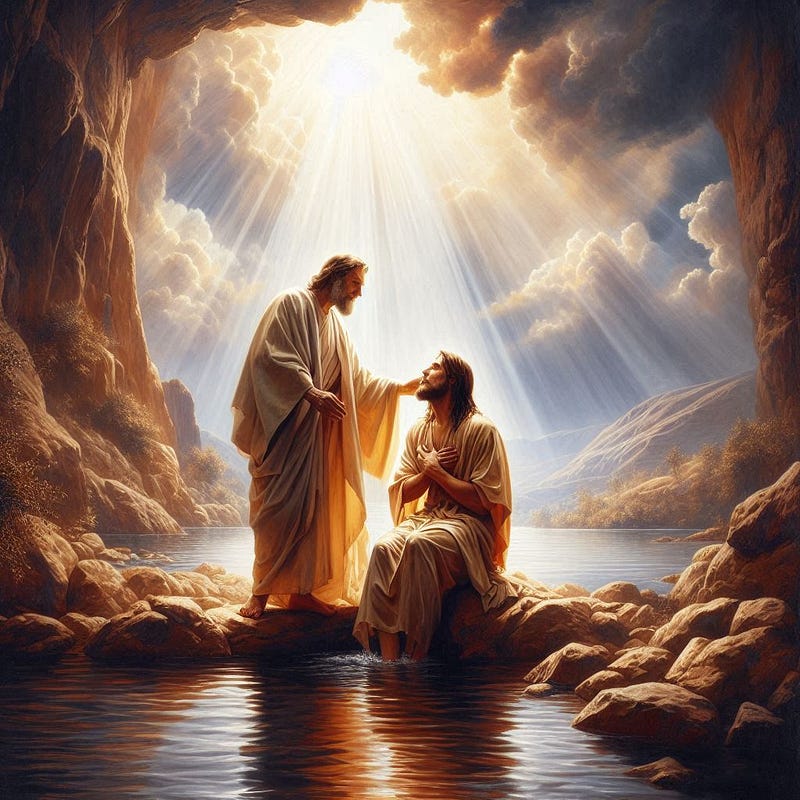
The Mandaeans are an interesting group that shares some roots with Abrahamic religions but also diverges substantially in their theologies. Mandaeism aka Nasoraeanism or Sabianism, got its start around the 1st century AD/CE and is thought to likely predate Christianity and likely pulls some of its origin from earlier Babylonian and Persian religions.
The Mandaeans are the last surviving gnostic sect and were possibly the first as well.
Whereas Christians view the Jewish Bible as their Old Testament and Muslims essentially have a rewritten version of the Old and New Testament with additions as their holy book the Quran, the Mandaeans have primarily three holy books: the Mandaean Book of John (Drāšā ḏ-Yaḥyā), The Qolasta, and the Ginza Rabba (the codex of Adam). None of these mirrors the Bible’s stories like the Quran does, although they do include some characters we are familiar with like Adam, Seth, Noah, Shem, and John the Baptist.
While Christians see John the Baptist (Enosh-Uthra to the Mandaeans) as essentially a herald of Jesus’ coming, and Muslims see him as a prophet who also foretold of Jesus’ (Isa’s) coming as the Messiah, Mandaeans see him as being the true Messiah.
They view Jesus on the other hand as being a false messiah who distorted John’s message and even believe that John hesitated to baptize Jesus due to feeling that Jesus wasn’t worthy to receive the baptism rather than the Christian depiction of John feeling that he himself wasn’t worthy to perform it. They also regard Abraham, Moses, and Muhammad as false Prophets.
Subscribe to continue reading the rest of this article.