
The Lowell Mill Girls
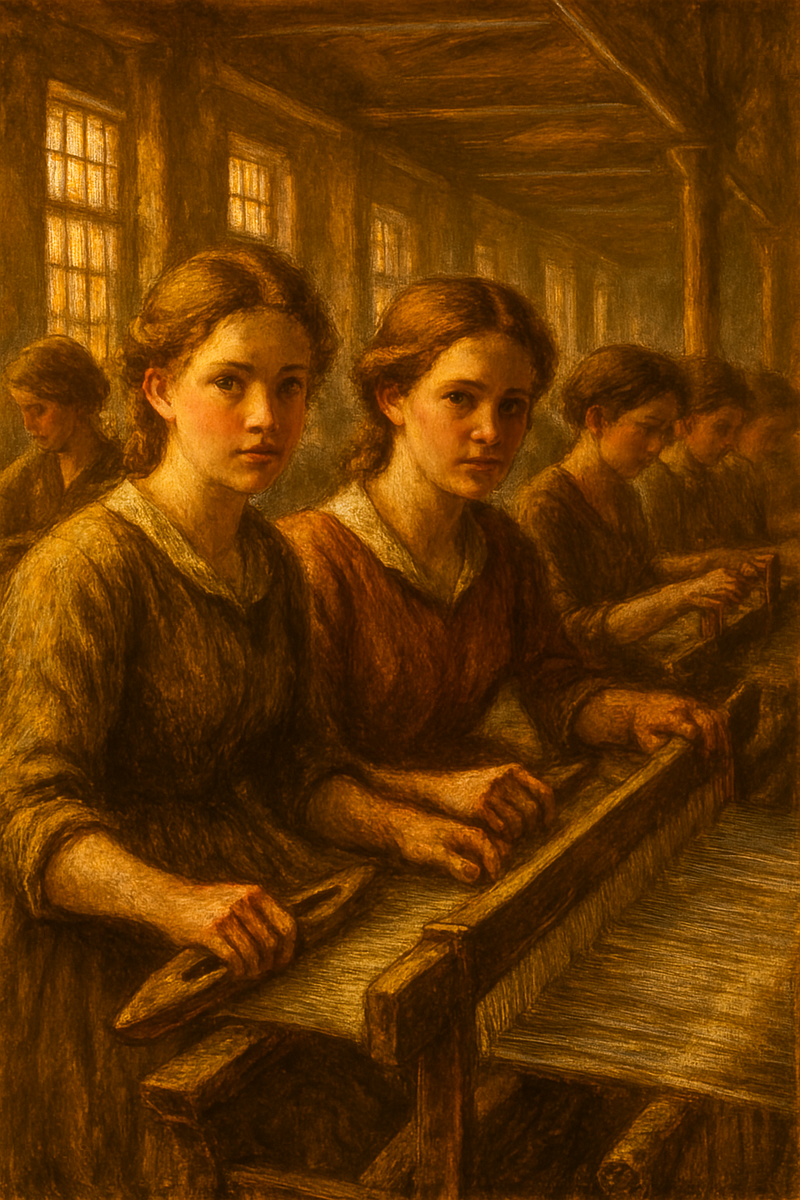
The Lowell Mill Girls

Long before suffragettes, and long before the term feminism was commercialized and marketed to us on T-shirts made by women in sweatshops overseas, there were the Lowell Mill Girls. Young women from the New England farms were sold an early version of the “you can have it all” myth to get them away from their families. They were promised they could be independent, educated and have employment at the textile mills in Lowell, Massachusetts. What they actually received was an early preview of corporate America.
The mills wanted girls between 15 and 30, old enough to work like adults, young enough to accept incredibly low pay and exploitation. They recruited them from poor farming families with promises of “opportunity” and “moral supervision.”
They’ll work you to the bone, but you’ll do it with a clean reputation and a curfew.
The company-run boardinghouses were sold as safe havens, rules, curfews, required church attendance, and rent automatically deducted from your paycheck. The perfect fusion of moral control and corporate efficiency.
You couldn’t drink, couldn’t date, couldn’t complain, and definitely couldn’t sleep in. You essentially got to live in a company-owned room for the privilege of working yourself half to death.
The idea was that this would be a respectable job for “virtuous young women.” Exploitation is fine as long as it’s done under the banner of decency, right?
The mills themselves were hellish.
Imagine 12 to 14 hours a day, six days a week, operating deafening looms that could rip off a hand if you phase out for a second. The air was thick with cotton fibers, so thick workers developed “brown lung,” a chronic respiratory condition that slowly killed you.
There were no breaks, no ventilation, and no worker protections. Back then, that would’ve been seen as “government overreach.” You worked until you dropped, and if you dropped too often, there were plenty of farm girls waiting to replace you.
The empowering “women entering the workforce” story you get in history textbooks is the sanitized version. This was a version of industrial feudalism that many in the U.S. see as the ideal, the “free market” without all those pesky laws restricting what a corporation can get away with. You didn’t own your time, your body, or even your bed. You were a living, breathing machine part, and if you broke, the system replaced you without hesitation.
The boardinghouses allowed the bosses to pretend to be your parents. They enforced curfews, made church attendance mandatory, and charged rent so high it ate into your already miserable pay.
But these same cramped quarters became the birthplace of something revolutionary: solidarity. Living side by side, these women began to realize they weren’t just unlucky, they were being systematically exploited.
When you put hundreds of exploited people under one roof and give them time to talk, something dangerous can happen, they can start to organize.
In 1834, when mill owners decided to cut wages by 15%, the “docile” mill girls walked off the job and flooded the streets in protest. Hundreds of them. They called themselves “daughters of freemen” and refused to accept being treated like property. Newspapers mocked them as “unfeminine” for daring to protest.
The expectation by the patriarchy was for them to be exploited with a smile. Their strike ended up failing, but it was frightening to management and made a point. The very next year, in 1836, they struck again, this time, over wage reductions and increased fees for boarding, capitalism trying to squeeze more out of them from two different fronts.
Once again, management was astonished that women could think, raise, and lead a rebellion all without the need for male authority. But the real revolution came in 1845 when the Lowell Female Labor Reform Association was created. Women lobbying the Massachusetts legislature for a 10-hour workday.
The right to work only ten hours a day was considered a revolutionary demand. That’s how low the bar was.
The Lowell Mill Girls contributed writing that was published in The Lowell Offering. They captured their experiences in vivid detail. They expressed their exhaustion, exploitation, and their dehumanization, being treated like cogs in a machine. But they also captured in their writing their dignity, their pride, and their worth far beyond being merely disposable labor.
“We are the daughters of freemen,” one wrote, “and we will not be trampled upon with impunity.”
These women, mostly teenagers, were writing political manifestos before they even had the right to vote.
Did they win? Not immediately. The mills stayed brutal. The hours stayed long. The pay stayed low. The “benevolent” industrialists got richer while their workers suffocated in cotton dust.
But their defiance planted a seed.
The strategies employed by these women, including organizing, walkouts, petitions, and the formation of associations, became the standard for all the labor movements that followed. The ideology that women were entitled to just compensation, reasonable working hours, and fundamental respect formed the basis of feminism in America. You can draw a straight line from the Lowell’s textile mills to the Seneca Falls suffragists and from there to the 20th century union organizers.
Today, their story gets trotted out as a quaint piece of industrial nostalgia, if it gets mentioned at all. “Look how far we’ve come!” while companies ship jobs overseas to recreate the same conditions under a new name. The real story is that they planted some of the first seeds of resistance against corporate power in America’s industrial story.
But telling the story in that light is dangerous for the ruling class. They don’t want to inspire any movements by people who may look around themselves and see parallels in their working conditions today.