
“The Lost Chronicles: Jesus in India — A Spiritual Odyssey”
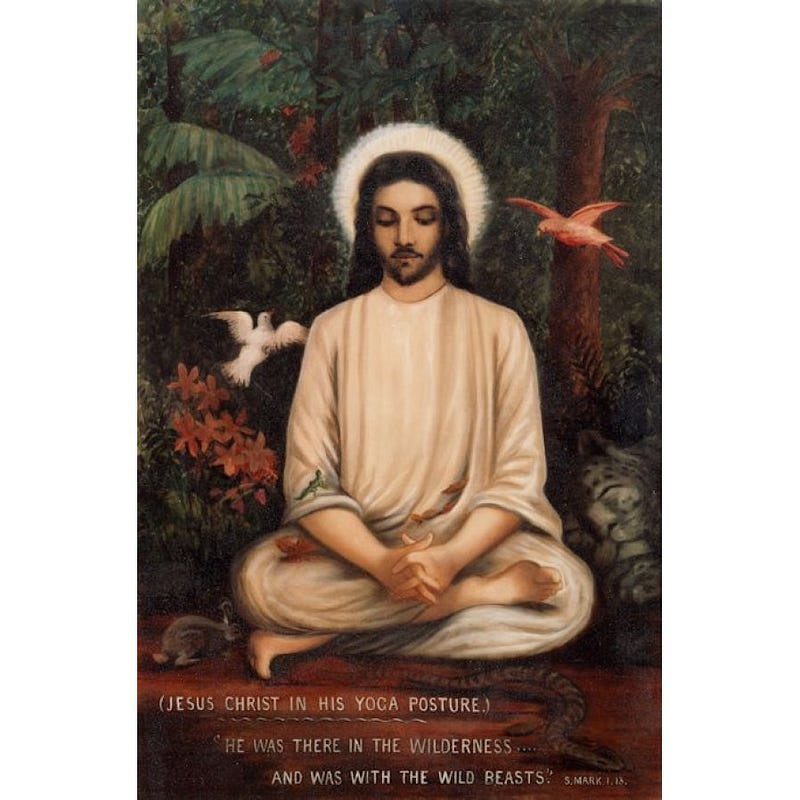
“The Lost Chronicles: Jesus in India — A Spiritual Odyssey”

Greetings, truth-seekers and history aficionados! Buckle up for a mind-bending journey into the lesser-known chapters of Jesus’s life, where the Holy Land meets the mystique of India. Spoiler alert: No, we’re not talking about the Bollywood version of the Bible. This is the real deal — or at least, the tantalizing speculation that Jesus may have had a spiritual sojourn in India.
A Detour to the East
So, picture this: Jesus, after the teenage years but pre-Carpenter-in-Chief era, decides to embark on an Eastern pilgrimage. Forget the sandals and robes for a moment; he’s trading them in for a kurta and some comfy sandals (a spiritual gap year, if you will). Why India? Well, why not? The guy loved parables, and India has its fair share of profound wisdom.
Alright, let’s dive deeper into the hypothetical detour that Jesus might have taken to the East, exploring some intriguing theories and references that add a touch of mystique to this spiritual odyssey.
The Missing Years
The Bible is somewhat sparse when it comes to detailing the “missing years” of Jesus — those mysterious decades between his adolescence and the commencement of his public ministry. Enter the intriguing assertion made by some scholars, including Holger Kersten in his book “Jesus Lived in India,” that during this period, Jesus might have embarked on a journey eastward, reaching the Indian subcontinent.
Holger Kersten’s book “Jesus Lived in India” is one of the notable works that proposes an alternative narrative for this period. Kersten suggests that Jesus, driven by a quest for spiritual enlightenment and knowledge, undertook a journey eastward, possibly to India. The theory draws from ancient texts, including the aforementioned “Bhavishya Purana,” which some interpret as describing Jesus’s visit to the subcontinent.
Ancient Textual Whispers
One of the breadcrumbs leading us to this hypothetical Eastern sojourn is found in ancient Hindu scriptures. The “Bhavishya Purana,” a Sanskrit text dating back centuries, contains passages that some interpreters believe describe Jesus’s visit to India. These verses, albeit subject to debate, allude to a foreign sage who disseminated spiritual wisdom in the East.
The relevant verses are in Chapter 23 of the Pratisarga Parva. They describe a conversation between the sage Maharishi Brighu and his disciple Bhavishya Maha Purana about future events. The verses in question, which some suggest could be interpreted as referencing Jesus, are as follows:
“O Brahmanas! In the land of the mlecchas, the followers of the Malechha dharma (adharma or unrighteousness) will increase. The adherents of the a-dharma will prevail over the followers of dharma. At that time, the Supreme Lord will descend on the earth in a divine incarnation. He will be born in a mlechha family and act like a devotee, performing activities like those of a pious person. His name will be Isa, a common name among the Malechhas.”
It’s worth noting that interpretations of these verses are contentious, and scholars have varying opinions on whether they refer to Jesus or have been misinterpreted over time. The name “Isa” is often associated with Jesus, and this has led some to draw parallels between the description in the Bhavishya Purana and the life of Jesus.
A Yogi Among Yogis
The concept of Jesus as a spiritual seeker aligns with the essence of Hindu philosophy. Proponents of this theory suggest that he might have engaged in deep philosophical discussions with Hindu sages, imbibing the profound teachings of Vedanta and yoga. Did he sit under a Bodhi tree contemplating enlightenment? Theories suggest that it’s not entirely implausible.
Some common themes we see:
- Parallel Teachings: Some proponents argue that there are striking similarities in the moral and ethical teachings of Jesus and Buddha. They point to shared themes such as compassion, non-violence, and the importance of love and forgiveness.
- Resurrection and Nirvana: Some comparisons are drawn between the resurrection of Jesus and the concept of Nirvana in Buddhism. Both are seen as transcending the cycle of birth and death, though the theological contexts and interpretations are quite distinct.
- Parallels in Stories: Some authors and researchers have pointed out perceived parallels in the stories of Jesus and Buddha, such as miraculous births, temptations, and renunciation of worldly pleasures.
- Universal Spirituality: Proponents argue that both Jesus and Buddha were spiritual teachers with a universal message, emphasizing inner transformation and the pursuit of a higher, transcendent reality.
There are also scriptural evidence of the Bible taking elements from Hinduism:
- Bible (Matthew 7:12): “So in everything, do to others what you would have them do to you, for this sums up the Law and the Prophets.”
- Vedas (Rig Veda 10.117.6): “Do not do to others what has been done to you.”
- Bible (Mark 12:29): “The most important one,” answered Jesus, “is this: ‘Hear, O Israel: The Lord our God, the Lord is one.’”
- Vedas (Rig Veda 1.164.46): “Ekam sat vipra bahudha vadanti” (Truth is one; sages call it by various names).
- Bible (Colossians 3:12): “Therefore, as God’s chosen people, holy and dearly loved, clothe yourselves with compassion, kindness, humility, gentleness, and patience.”
- Puranas (Bhagavad Gita 16.3): “Merciless, greedy, and always ready to cheat; these qualities, O son of Pritha, belong to one born with demonic qualities.”
- Bible (1 John 4:18): “There is no fear in love. But perfect love drives out fear because fear has to do with punishment. The one who fears is not made perfect in love.”
- Puranas (Bhagavad Gita 16.3): “Fearlessness, purity of heart, self-restraint, non-violence, compassion for all beings, truthfulness, kindness, gentleness, and sincerity.”
- Bible (Matthew 13:31): “Another parable put he forth unto them, saying, The kingdom of heaven is like to a grain of mustard seed, which a man took, and sowed in his field.”
- Bible (Luke 17:21): “Neither shall they say, Lo here! or, lo there! for, behold, the kingdom of God is within you.”
- Chandogya Upanishad: “There is a spirit that is mind and life, light and truth and vast spaces. He contains all works and desires and all perfumes and all tastes. He enfolds the whole universe, in silence is loving to all. This is the spirit that is in my heart, smaller than a grain of rice, or a grain of barley, or a grain of mustard-seed…This is the spirit that is in my heart, greater than the earth, greater than the sky, greater than heaven itself, greater than all these worlds.”
There are also non-canonical Christian scripture instances that we can take a look at:
- Gospel of Thomas 22: “Jesus saw some babies nursing. He said to his disciples, ‘These nursing babies are like those who enter the (Father’s) kingdom.’ They said to him, ‘Then shall we enter the (Father’s) kingdom as babies?’ Jesus said to them, ‘When you make the two into one, and when you make the inner like the outer and the outer like the inner, and the upper like the lower, and when you make male and female into a single one, so that the male will not be male nor the female be female, when you make eyes in place of an eye, a hand in place of a hand, a foot in place of a foot, an image in place of an image, then you will enter [the kingdom].’”
- Possible Parallel in Vedas: Some see parallels with the idea of transcending dualities and achieving a higher state of consciousness, which is a recurring theme in Vedic philosophy.
- Gospel of Thomas: “Jesus said, ‘If those who lead you say to you, “See, the kingdom is in heaven,” then the birds of the heaven will go before you; if they say to you, “It is in the sea,” then the fish will go before you. But the kingdom is within you, and it is outside of you. When you know yourselves, then you will be known, and you will know that you are the sons of the living Father. But if you do not know yourselves, then you are in poverty, and you are poverty.’”
- In the Vedas and Upanishads, the concept of God being everything, pervasive in all aspects of creation, is often expressed through the idea of “Brahman.” Brahman is considered the ultimate, unchanging reality or principle in Hindu philosophy, and it is often described as immanent in the universe. As an example: Chandogya Upanishad 3.14.1 (Chāndogya Upaniṣad): “tattvamasi śvetaketo vṛṣaṇneva gārgyaḥ tattvamasi tattvamasi” English: “You are That, O Shvetaketu, you are That.” The repetition of “tattvamasi” emphasizes the identity between the individual self (Atman) and the ultimate reality (Brahman), conveying the idea that the essence of the individual is none other than the essence of the universe itself. This teaching underscores the concept that God is not just a distant creator but is immanent in all of creation.
Shrouded in Kashmir
Now, let’s fast forward to the later chapters of Jesus’s life, according to this speculative narrative. The claim that Jesus spent his final years in Kashmir finds support in local traditions and a tomb in Srinagar, known as the Roza Bal. Some believe this tomb houses the remains of Jesus, adding a layer of mystery to the question of his ultimate fate. This theory claims that he lived out the rest of his life there, being buried in his 70s-80s, rather than dying at the age of 33 on the cross.
Ancient Manuscripts and Unearthed Wisdom
“The Aquarian Gospel of Jesus the Christ” by Levi H. Dowling is another piece of the puzzle. While not considered part of the canonical Gospels, this work introduces a narrative of Jesus’s travels to the East and his interactions with spiritual leaders. Critics may question its authenticity, but it contributes to the intriguing tapestry of the theory.
While these theories are speculative and not universally accepted, they offer a fascinating glimpse into a potential detour that challenges the conventional narrative of Jesus’s life. Whether or not he indeed traveled to the East and imbibed the teachings of Hinduism remains a tantalizing mystery, echoing through the corridors of both religious history and the human imagination. I find this also challenges those of us who were raised in Christianity by possibly focusing specifically on his teachings as his most valuable contribution to mankind, rather than the act of dying on the cross as a sort of blood sacrifice.