
Selling Death
Selling Death
Profits > Brown Lives

When a chemical is found to be too toxic for rich countries, the corporations behind it don’t just let it go to waste!
They dump it on someone poorer.
The factory keeps running, the profits keep flowing, and the poison just gets a new shipping label.
Call it “regulatory offshoring,” or just call it what it is: the same old exploitation, with better PR.
It’s a well-rehearsed script:
Step 1: Scientists raise hell about the dangers.
Step 2: Wealthy nations slap on partial bans, safety stickers, or smug reform campaigns.
Step 3: The exact same product quietly ships to places with fewer rules, weaker press, and no lawyers circling overhead.
I’ve got the receipts, the worst offenders, the chemicals, the brands, and the countries they keep poisoning. None of this is theoretical. It’s all documented in regulatory filings, NGO reports, and court cases. The pattern’s obvious: ban here, dump there.
When a product becomes too risky for the home market, you don’t kill it, you relocate it. You slap on a different label, warehouse it until the news cycle moves on, or just sell it in a market where regulators are underpaid and under threat. It’s a two-tier safety system: clean, “ethical” versions for the wealthy; cheaper, dirtier, deadlier versions for everyone else.
This is modern corporate colonialism.
Brominated Vegetable Oil (BVO)
BVO came straight off the industrial shelf, where it was busy doing its original job as a flame retardant. At some point, someone decided, “Hey, let’s drink it,” and it was rebranded as an emulsifier to keep citrus flavors mixed in sodas. For decades, Americans guzzled the stuff while regulators twiddled their thumbs.
Mountain Dew, anyone?
It wasn’t until 2024 that the FDA finally revoked the use of BVO in food and drink products. It wasn’t because they suddenly acquired new knowledge or they cared about people’s health, it was because toxicology reports and consumer outrage made it impossible to keep ignoring.
Just because the FDA pulled the plug domestically doesn’t mean the product magically vanished from the planet. Corporations reformulated U.S. recipes for the PR win, while older inventory and “international market” versions kept flowing.
Nobody was in a rush to waste all that profitable, toxic stock.
Drinks in the U.S.? Cleaned up. Drinks in Latin America, parts of Asia, and elsewhere? Still laced with BVO long after the American version was scrubbed. Same brands, same logos, just a different recipe depending on where you live.
Not an accident, or oversight. A business decision.
BVO builds up in body fat and has been linked to memory loss, skin problems, and hormone disruption. Selling it in poorer countries while quietly phasing it out at home isn’t just hypocrisy it’s pure evil…
Industrial Trans Fats
Partially hydrogenated oils, the miracle ingredient of the junk food industry. They fry fast food, puff up cookies, and keep those cardboard-box pastries “fresh” for months.
And they’re a slow-acting poison.
In rich countries, trans fats have been mostly phased out, because the science got so damning they couldn’t spin it anymore. The WHO’s been shouting about this for years, and now dozens of nations have “best-practice” bans.
But in much of the world? Street vendors and snack makers still ladle these oils like liquid gold. Multinational food giants and local producers keep pushing them because they’re cheap, they last forever, and they hook customers.
Meanwhile, the people eating them, often in places with weak healthcare and regulatory systems, get the bill in the form of clogged arteries, heart attacks, and strokes.
BHA & BHT
BHA and BHT are synthetic antioxidants, lab-made preservatives designed to keep fats from going rancid and flavors from fading.
It all sounds amazing if it weren’t for the toxic effects it has on human health.
The EU and Japan have slapped restrictions or bans on them over cancer concerns, and the UK just tightened regulations in 2024 as well.
In the U.S. and much of the world, they’re still right there on the ingredient list in cereals, cookies, chips, and even cosmetics.
What’s even more infuriating is that the exact same brands sell “clean” versions in Europe while shipping BHA/BHT-laced products to Latin America, Africa, and Southeast Asia. It’s a business strategy.
Cheaper formulas mean longer shelf life, bigger margins, and no pesky lawsuits from markets that don’t have the political muscle to push back.
rBST / rBGH
Recombinant bovine growth hormone (rBST, rBGH) was a gift from biotech to dairy corporations, a way to make cows pump out more milk. It’s been banned for decades in the EU, Canada, Japan, and Australia over animal welfare issues and possible human health risks.
The U.S.? Still allowed. No mandatory labeling. Although many milk brands will list whether their product is “rBST/rBGH free” voluntarily.
When the U.S. exports its dairy, or when international brands source from U.S. supply chains, this hormone-laced/contaminated milk can slip right into markets that already did the right thing by banning it years ago.
These growth hormones end up causing more infections in cows, altered milk composition, and there’s evidence linking it to prostate, breast, and colorectal cancers in humans.
But if you live in a country without the political leverage to set the rules, or one with a for-profit healthcare system, you’re part of the experiment whether you like it or not.
Artificial Food Dyes
Red 40. Yellow 5. Yellow 6. The chemical Skittles of the industrial food world, cheap, shelf-stable synthetic dyes whose job is to make junk food pop like a toy commercial. Europe slaps warnings on some of them and forces reformulation. A few U.S. states have started phasing dyes out of school meals. The FDA, after decades of foot-dragging, is finally reviewing whether these colors belong in kids’ diets at all.
But in much of the Global South?
The kids’ aisle in many countries still glow with these artificial neon colors, ignoring the negative health effects these products will have on children. They do this because natural alternatives cost more, spoil faster, and don’t deliver the same cartoon-ad brightness that they know will get children addicted.
The science linking these dyes to hyperactivity, allergic reactions, and other health impacts isn’t anything new. What’s new is how openly the double standard plays out: cleaner versions for rich markets, rainbow chemistry for everyone else.
And “choice” doesn’t mean much when the only affordable option is the one that comes with a side of health risk.
“Pink Slime”
Lean Finely Textured Beef (LFTB), lovingly known as “pink slime,” was supposed to be a clever industry hack: they take fatty beef trimmings that’d usually be trashed or used as dog food, heat them, spin them in a centrifuge, treat the resulting paste with ammonium hydroxide or citric acid to kill bacteria, then blend it into ground beef to lower fat content and cost.
When U.S. consumers learned about it, the outrage was loud enough to push companies into rebranding, reformulating, or quietly pulling back, at least where cameras were rolling.
But globally? The process didn’t disappear. It just shifted to export markets and contract supply chains where oversight is thin, protein is scarce, and price pressure wins every time.
The ugly part isn’t just the chemistry. It’s the legal invisibility. Even in the U.S., after the beef industry sued ABC News into a settlement for calling it “pink slime,” there’s still no requirement to label it.
Talc & Asbestos
Cosmetic talc is something that sounds like it should be harmless. But as it turned out some of it was contaminated with asbestos fibers, the same carcinogen in old insulation and brake pads.
Johnson and Johnson’s own lab tests from 1972 to 1975 found asbestos in its talc, sometimes at “rather high” levels, and documents from the 1950s and 1970s show J&J considered using citric acid to “depress” asbestos levels in mined talc, indicating they were fully aware it was present.
So these monsters were knowingly selling contaminated products used on babies in the U.S. for around 72 years…
That contamination has been linked to ovarian cancer and mesothelioma.
After billions in lawsuits and a PR meltdown, J&J pulled talc-based baby powder from U.S. and Canadian shelves in 2020, then announced a full global phaseout in 2022–2023.
But quitting a product in the rich world isn’t the same as removing it everywhere. Old inventory doesn’t magically vanish. Distributors push it into lower-scrutiny markets, smaller brands keep grinding talc, and consumers in poorer countries keep buying it, often unaware it’s the same stuff J&J can’t sell at home.
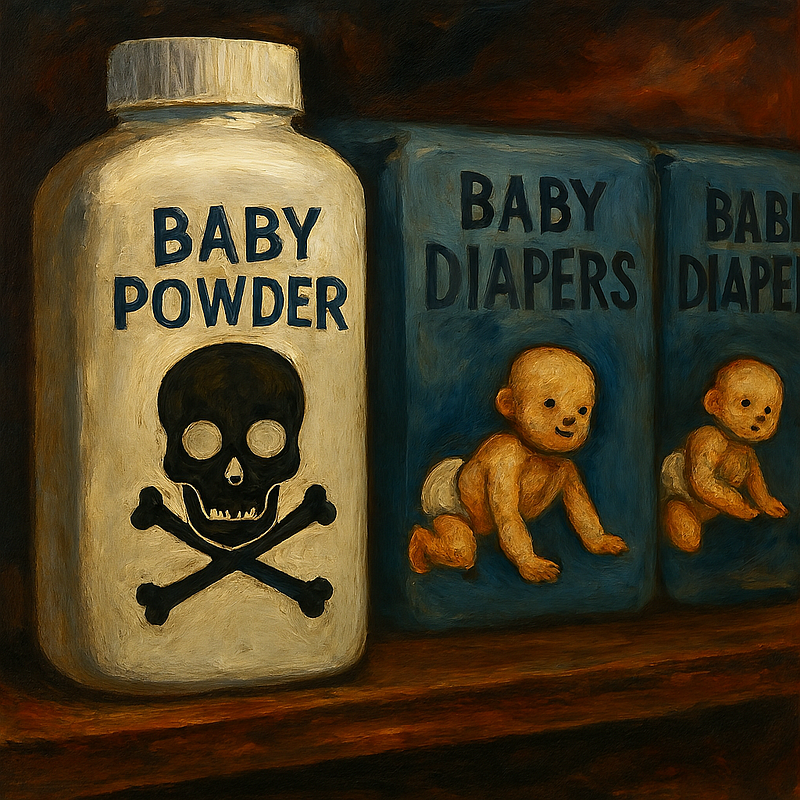
Sadly, this stuff is still on the shelves in much of Latin America, right next to the baby diapers.
Imagine how evil you have to be to sell a product that results in someone unwittingly exposing their baby to something that could result in respiratory or reproductive cancer. People who have been conditioned to trust your brand.
Triclosan
Once marketed as a germ-killing miracle for soaps, toothpastes, and even cutting boards, triclosan is now more embarrassment than a selling point. The FDA banned it from consumer hand soaps in 2016 after links to hormone disruption, antibiotic resistance, and immune problems.
Europe moved too. Rich-country brands reformulated.
Overseas, triclosan still lurks in toothpaste, antiseptics, and personal care imports. Weak enforcement and patchwork bans mean it slips through, and the outrage that killed it in the U.S. barely registered elsewhere.
Formaldehyde-Releasing Preservatives
DMDM hydantoin. Quaternium-15. Imidazolidinyl urea.
These are preservatives that work by slowly leaching formaldehyde, a known human carcinogen, into your shampoo, lotion, or salon treatment to keep microbes at bay. The EU has slammed the brakes on them, and big brands reformulate for high-scrutiny markets.
But in budget cosmetics, off-brand salon products, and imports in countries with weaker rules? They’re still common. The appeal is obvious: they’re dirt cheap, shelf-stable, and effective. The tradeoff is daily low-dose exposure for people least likely to have access to safer alternatives.
It’s the same pattern every time: cleaner formulas for those who can demand them, chemical shortcuts, with higher profit margins, for those who can’t.
Phthalates Hiding in “Fragrance”
Phthalates make scents last longer. They also mess with hormones, damage reproductive health, and cause developmental problems. The EU has cracked down on several and big brands quietly reformulate for Western markets.
But here’s the trick: “fragrance” is still a legally protected black box in most labeling laws. Companies don’t have to say which chemicals are in it, so they can tuck phthalates behind that word and keep selling old formulas anywhere the rules are weak.
Soaps, lotions, candles, and air fresheners in low-regulation markets can still carry the same hormone-disrupting compounds that rich countries phased out years ago.
Chlorinated Chicken
In the U.S., industrial poultry often gets a chlorine bath to kill pathogens. In the EU, that’s banned, mainly because it’s a chemical Band-Aid for overcrowded, filthy factory farms. Different farming standards mean different rules, and it’s been a flashpoint in trade disputes for decades.
The science isn’t pretty. When chlorine hits meat, it creates chlorinated byproducts, some cancer-linked, some that mess with hormones, and some scientists are still figuring out.
The residue can disrupt gut bacteria and chip away at your immune system. But the real red flag? You wouldn’t need to douse chicken in chemicals if the farms were clean to begin with.