
Peaceful Protests
Peaceful Protests
Do They Bring Results?

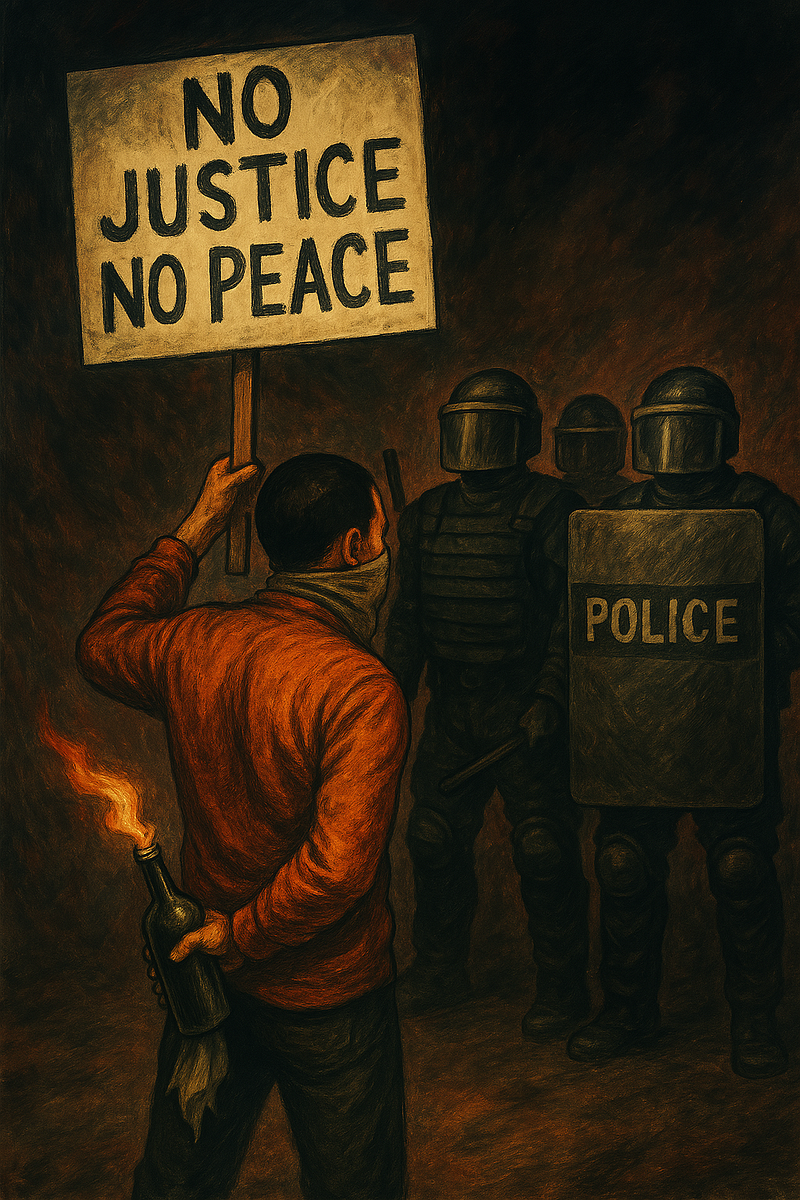
Peaceful protests, by themselves, don’t change anything. Not unless they come with a shadow. A threat. A looming “or else.” Marches, chants, signs, these are theater unless the people in power feel that if they don’t concede something, their world might start burning.
And I do mean that literally.
That’s not cynicism. That’s history.
The people in charge don’t care if you’re mad and are demanding change. They don’t care if you tweet or hashtag, sit in front of their buildings with signs, or wear pink hats in front of the Capitol. They care when their private security teams start updating threat assessments. They care when their gated communities feel a little less secure. Or when their profits, their schedules, their daily comforts are threatened.
You want to know when the civil rights legislation started moving in the ‘60s? It wasn’t when Martin Luther King Jr. gave his famous “I Have a Dream” speech. Or when people marched peacefully across bridges. It wasn’t until after MLK was assassinated and cities across America erupted in flames that any real change was allowed to occur.
The Civil Rights Act was passed after the violent riots in Watts, Detroit, and the uprising in Newark, not before.
Riots didn’t kill the movement. They pushed it forward.
Deep down, the ruling class knows this.
Johann Rupert, billionaire head of the Richemont group, which owns Cartier, once admitted it flat out:
“We are in for a huge change in society. Get used to it. The middle class is going to disappear, and the only thing that keeps me awake at night is the poor rising up.”
That’s a man who owns luxury watch companies confessing his insomnia is caused by the thought of people like you realizing what’s been done to them.
The illusion they sell you is that protest should be polite. That change comes from dignity, not disruption. That throwing a brick through a window makes you a criminal, but evicting a thousand families makes you a visionary CEO. That violence is never the answer, except when it’s their drones, their tear gas, their batons, or their cops kneeling on your neck.
Violence is the tool of the oppressor.
The threat of violence? That’s one of the few tools the oppressed have left at our disposal.
A prime example of this is the Black Lives Matter movement. It was growing, peaceful, and organized for years. But when George Floyd was murdered on camera, and America finally lost it, they listened. Police departments started panicking. City councils started talking about defunding. Corporations started issuing diversity pledges not because they suddenly cared, but because a Target was on fire, and they knew more could follow.
Now, let’s take a look at Occupy Wall Street. One of the largest peaceful protest movements in recent American history.
During Occupy, thousands of people camped out in parks, marched through cities, held handmade signs, passed around food, and chanted about the 99%, naively hoping the rich and powerful might suddenly grow a conscience and allow a little justice to trickle down. These weren’t armed radicals. They weren’t even ready to fight back. But that didn’t stop the police from rolling in like they were facing down an insurgency — batons out, pepper spray locked and loaded, decked in full riot gear like they were going to war. They knew these people wouldn’t fight back. That’s what made it easy. So they beat them, caged them in metal barricades, sprayed them in the face while they sat cross-legged in the street, then dragged them off to jail like they were dangerous criminals instead of just… idealistic citizens asking for a livable world.
What changed? Nothing structural. No banking reforms. No wealth redistribution. The movement was crushed, co-opted, and buried beneath headlines about public disturbances and sanitation. Why? Because peaceful protest, without the threat of real consequences, is just noise to the ruling class. They don’t listen until they’re scared. And Occupy proved they weren’t.
Contrast that with Luigi Mangione, one individual guy who allegedly assassinated a healthcare CEO after being denied care by the very system profiting from his suffering. The media called Luigi a terrorist, not because he caused mass chaos, but because he shattered a myth they need us to believe, that the powerless will always stay quiet, no matter how much they’re crushed.
He didn’t hold a sign or give a speech. He didn’t wait for permission to be heard. He struck at the rotting heart of a system that gets rich off human misery. Most people didn’t recoil in horror. They nodded. They understood. Deep down, they’d felt that same rage, just never saw anyone actually act on it. Most people could share their own stories of receiving rejection letters from their health insurance companies, and felt zero sympathy for the “victim”.
The response from the ruling class? Panic. Not just because of what he did, but because of the precedent being set, what it represents. The fear that someone might finally say enough and follow through, and others may follow their example.
Within days of the CEO’s assassination, UnitedHealth began approving a tidal wave of previously denied claims. Cancer treatments. Surgeries. Life-saving meds. It was like the floodgates opened. Not out of compassion, but out of fear. BlackRock, smelling blood in the water, sued UH for undermining shareholder value, accusing them of paying out too much too fast. That’s how upside-down the system is: help sick people, and you get sued for not being cruel enough. Luigi‘s single act of defiant violence accomplished what a thousand polite emails, candlelight vigils, Change.org petitions, and Occupy sit-ins couldn’t.
For the first time, the machine felt pain and fear.
He forced them to feel the consequences of their indifference. He showed them what it looks like when people stop begging and instead find justice themselves.
That’s exactly why you’re not hearing the truth about what happened with the recent Blackstone assassination.
One of the most powerful financial firms on Earth, Blackstone, with ties to every industry from real estate to surveillance tech to private equity plunder, just had a major executive taken out. And what’s the media saying? Definitely nothing about it being tied to class warfare. Just move along, folks.
If the working class realized that the ruling elite are not gods, but mortals who can bleed, it would shatter the entire illusion. It would expose how scared they really are. They don’t want you to know that one calculated act can do more damage to the system than a thousand think pieces.
They don’t want you to know that the system is only stable because you let it be.
Understand this: peaceful protests only work when there’s a credible threat of something more. Gandhi’s nonviolence worked because the British Empire feared a larger, uncontrollable uprising. MLK’s vision worked because Malcolm X was right around the corner. The Black Panthers were watching. The cities were simmering. Without Malcolm and the Panthers setting the backdrop of the real potential for revolution, MLK’s nonviolent message was just noise to the ruling class.
Peaceful protests can bring awareness, but they rarely bring about power shifts. Unless there’s they’re backed up by the unspoken threat of what happens if peace fails, their messages won’t be heard. For instance, France’s Yellow Vests movement back in 2018 brought weeks of civil unrest, but it was only after riots erupted that Macron froze the fuel tax hikes.
Another great example is the Russian Revolution. It didn’t start out violent. It started with workers, mostly women, marching peacefully in the streets of Petrograd in 1917, simply demanding bread, better wages, and an end to a pointless war that was bleeding the country dry. They weren’t asking to burn the palace down. But the Tsar didn’t listen. Instead, troops opened fire. So peace gave way to fury, and the working class realized negotiation was a dead-end. What followed was one of the most explosive uprisings in human history. The Romanovs were wiped out, land was seized from the aristocracy, and for the first time, peasants and workers got a taste of control over their own destiny. Say what you will about the Soviet Union’s eventual failures, but the revolution broke the back of a centuries-old feudal system. And that didn’t happen through polite petitions.
Same story in Cuba. Fidel and the July 26th Movement didn’t show up with rifles on day one. Before the revolution, there were years of resistance movements, peaceful protests, and reform attempts against Batista’s U.S.-backed dictatorship. Any dissent was met with torture, murder, and mass disappearances. When peaceful routes were extinguished, the revolution became inevitable. And when it came, it dismantled a parasitic plantation economy, kicked out foreign oligarchs, nationalized healthcare and education, and gave the Cuban people something they’d never had: sovereignty. The West still foams at the mouth over Cuba not bowing to the IMF or letting corporations run wild, because the revolution did what polite democracy never could, and they’re terrified others would follow this example, so they smear Cuba at every chance and do everything they can to keep them cut off from trade.
We can’t forget to mention the French Revolution. The people of Paris weren’t blood thirsty, and their first choice wasn’t to storm the Bastille; it came after years of failed reforms, famine, and tax burdens dumped squarely on the poor while the clergy and aristocracy lived like gods. There were appeals, petitions, and summits. The king ignored them all. Then the guillotines came out. Heads rolled, but so did centuries of monarchy and “divine right”. What followed birthed radical ideas that reshaped the modern world, equality before the law, secular government, and the belief that no one rules by blood alone. None of that came from a peaceful protest. It came from the terrifying realization by the elite that the people would rather burn the system down than be buried under it.
These revolutions have reverberated with the ruling class ever since. They are the only reason they occasionally make appeasements to the working class, to this day. But the ruling class doesn’t seem to be as afraid as they once were. They’ve spent decades dividing up the working class, convincing us that immigrants are the problem, people of a different political stance, sexuality, race, etc. Anything to prevent unity among the ranks.
Power only listens when it fears it might lose control.
If you’re still clinging to the fantasy that polite resistance will save us, you need to wake up to reality. You’re not resisting, you’re stalling.
I’m not advocating violence. But I am saying the possibility of it is what makes power listen. That’s not immoral, it’s survival.
The ruling class sleeps easy when protests come with permits and end by sundown. But when the streets swell, when the signs get angrier, when buildings start shaking and CEOs start googling “private island bunkers”, that’s when change becomes real.
The only language the ruling class understands is violence.
The people have to be willing to speak it.