
Malcolm X Saw Palestine Clearly
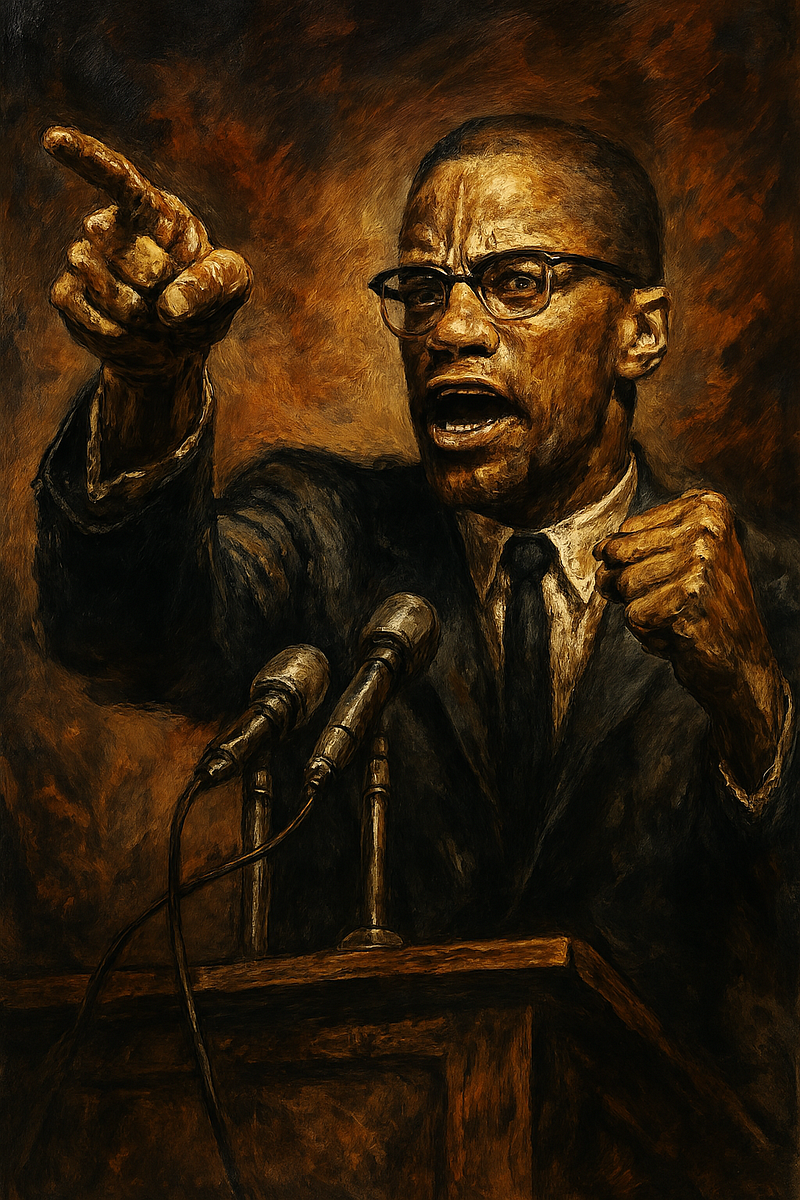
Malcolm X Saw Palestine Clearly
As a People Suffering Under Colonialism in Disguise

In the U.S., Malcolm X usually gets remembered in the sanitized, bite-sized way that makes him safe for history books, his firebrand speeches against American racism, his call for Black self-determination, and his transformation from Nation of Islam minister into a global human rights leader.
What gets buried, intentionally, in most cases, is that long before it became “controversial” or “politically risky” to say it, Malcolm X was openly drawing a straight line between the oppression of Black people in America and the oppression of Palestinians under Israeli rule.
This wasn’t some feel-good “world peace” slogan you slap on a Hallmark card and forget about. It was a calculated, hard-edged political position Malcolm had been hammering into shape since his 1964 tour of Africa and the Middle East. By then, he’d kicked down the polite little box America tried to keep him in.
Civil rights? He saw the civil rights struggle for what it was, just one flank in a global war against colonialism, with the same empire pressing its boot on necks from Mississippi to Mozambique, from Santiago to, yes, Palestine.
So when he stepped into the Khan Younis refugee camp that September, he didn’t buy the West’s bedtime stories about “ancient grudges” or “religious complexities.”He saw it for what it was, occupation, raw and unvarnished, and he said so. No euphemisms. No soft edges. He saw what it really was, colonial violence wearing a fresh uniform. He saw something he knew all too well: a people stripped of their homeland, trapped under the boot of military power, humiliated, impoverished, and brutalized by a system designed to keep them there. As he put it in Cairo the same year:
“The problem that exists in Palestine is not a religious problem… It is a question of colonialism. It is a question of a people who are being deprived of their homeland.”
For Malcolm, the parallels to the Black condition in America were obvious. In both cases, the oppressor wrapped their dominance in a moral justification, in one case “Manifest Destiny” and the mythology of the American frontier, in the other, a biblical land claim wielded to justify modern displacement. Malcolm skewered this logic with surgical precision:
“Zionist logic is the same logic that brought Hitler and the Nazis into power… It is the same logic that says that because my grandfather came from Ireland, I have the right to go back to Ireland and take over the whole country.”
Malcolm didn’t care if the colonizer wore a cross, a crescent, a Star of David, or wrapped themselves in the red, white, and blue. Colonialism was colonialism. White supremacy was white supremacy. It just switched costumes depending on the stage, learning to pray in whatever language would best disguise its theft as destiny.
His time in the Arab world sharpened that global lens. Standing in Gaza, he told Palestinians something that could have been said just as easily to the sharecroppers in Mississippi or the tenants in Harlem:
“Our problem in America is a problem that is worldwide.”
By then, Malcolm had already broken from the Nation of Islam’s narrow separatist box. His vision was bigger now, solidarity with the oppressed, no matter the religion. Muslim, Christian, Jewish, it didn’t matter. His beef wasn’t with faith, it was with power using faith as a shield while it bulldozed people off their own land. He opposed the displacement of an indigenous people, the denial of their right to self-determination, and the Western imperial machine, especially the U.S., that kept the gears grinding.
This wasn’t some safe, wine-and-cheese “progressive” talking point for the 1960s crowd. It was political dynamite. The mainstream civil rights movement treated Palestine like a live wire, too risky to touch, too likely to get you labeled antisemitic or cut off from donors. Malcolm didn’t blink.
Liberation that stopped at America’s borders wasn’t liberation, it was PR.
He didn’t put much faith in the so-called “two-state solution” either. His demand was plain:
“We need a free Palestine.”
Sixty years later, the same playbook’s still in use. colonialism dressed up as “security,” injustice gift-wrapped in the language of religion and history, the dispossessed told to sit tight for a “peace process” that’s just an expensive waiting room for permanent occupation. And the same voices that tried to shut him up then now pretend solidarity between Ferguson and Gaza, or Minneapolis and Jenin, is some brand-new radical fad.
It’s not new. Malcolm X saw it in 1964. He named it. And for that, just like for so much else, he was far ahead of his time, and was eliminated for it.