
Gay Couples in the Bible
Gay Couples in the Bible
A discussion of gay couples in the Bible

We always hear from Christians about how homosexuality is a sin, and they like to cite one of six verses to make that claim. Each of those verses has been twisted from their original languages and used for ulterior motives, as I have detailed in another piece I wrote that I’ll link at the bottom of this article. With that in mind though, what evidence do we have of homosexual couples in the Bible itself?
David and Johnathan
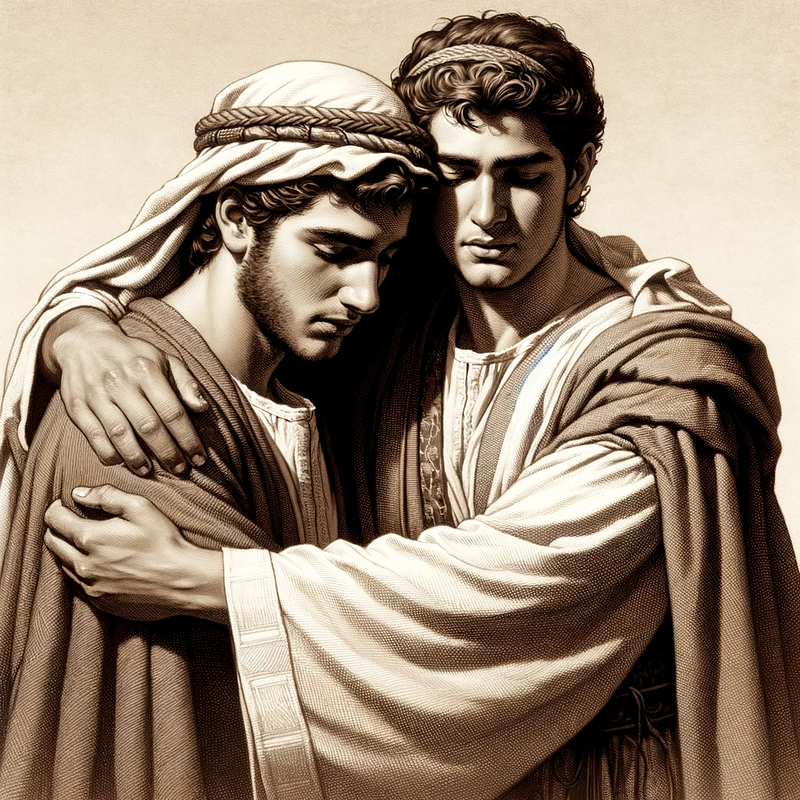
Let’s start with the most discussed possibility, David and Jonathan from the Old Testament. There are several verses here that show their closeness, Jonathan stripping down and showing his vulnerability to David, them kissing, and David stating his love for Johnathan was “greater than that of a woman” and that his “soul was knit” to Jonathan’s, they even made a covenant before God, with wording similar to that of wedding vows. David shows an extreme amount of grief for Jonathan when he dies, and even adopts his son as his own.
1 Samuel 18:1,3–4
1 Samuel 20:8
8
1 Samuel 23:18
In another section we see that when Saul finds out that David had found “favor” in Jonathan’s eyes he becomes angry with him, and David fears Saul is going to kill him. So David meets up with Jonathan to make a plan, and near the end of the section, they cry together and kiss.
1 Samuel 20:3,41
3
wept
Christians of course like to try to dismiss all of this as a “friendship”, but I think with what evidence we have here, and the fact that we know parts of the Bible were removed and edited by biased scholars against this sort of relationship…it seems pretty clear cut to me what the truth of the situation was. Let’s take a look at the verses that support this theory.

Saul and David
The next one still involves David. When he was younger he was selected to be King Saul’s armor bearer. Saul also appreciated him for his beauty and skill in playing a harp to him in private. This sort of dynamic is seen around the world in ancient cultures where older, more powerful men, sometimes warriors, would take on essentially a younger man or even boy as a partner.
When David meets Jonathan and gains a previously mentioned “favor in his eyes” we see this jealous, even murderous rage come out of Saul. Saul even calls out Jonathan and uses phrasing that would be used against a son who slept with a father’s wife, helping to show the possible dynamic between Saul, David, and Jonathan.
Referring to this verse.
Upon Saul and Jonathan’s death, David grieves for them both using the term beloved.

Ruth and Naomi
Ruth and her mother-in-law Naomi both are widowed and Ruth pledges loyalty to her for the rest of her life similar to a wedding vow, even using the term in the following verse “cleave,” which we see reflected in Genesis in reference to Adam and Eve.
Given this sort of relationship wouldn’t have been accepted at the time, it isn’t too much of a stretch of the imagination that they’d need to find a “beard,” and make the relationship not stand out much in society. So later on Ruth, at the instruction of Naomi, seduces this guy Boaz who has legal rights to be able to marry her as a widow.
She marries him (love is never mentioned), has a kid with him, and upon the birth of that child, the neighborhood women celebrate that Naomi…not Boaz, had a son. It seems like maybe the neighborhood women were keen on the arrangement.
Ruth 1:14,16
orshall be
Ruth 4:16–17

Centurion and Servant
In the New Testament, there is a story about a Roman centurion who comes to Jesus to ask him to heal his servant, but he uses the word “pais” which in Greek usually translates to a son or servant, but in some contexts could be referring to a lover that was younger than him. Also given that centurions weren’t allowed to marry it makes it less likely it would’ve been his son.
The amount of concern this centurion shows, as well as his willingness to throw himself down in front of a Jewish man and plead for him to heal his servant, seems out of place for what a master would do for a servant and shows that the centurion isn’t that concerned with social norms.
Matthew 8:5–10
5 6 7 8 9 it10 this
Jesus’ reply here in verse 10 is normally taken as the centurion’s faith in Jesus, but it could also be interpreted as his faithfulness to his partner, that he would seek out help from a Jewish man whom Romans were there to police, and risk his own humiliation by society to try to seek healing for him.